David Henniger
The ForgivenDavid Henniger is a British doctor whose collision with Driss transforms a holiday in Morocco into a confrontation with responsibility that he repeatedly tries to evade. His journey to Tafal’aalt brings him face to face with the dead boy’s father, Abdellah, and gives him an experience he interprets as forgiveness; his confidence in that reprieve, however, cannot undo his earlier concealment or prevent Ismael from recognizing him later.
Identity and Arrival
David travels with his wife, Jo Henniger, arriving in Africa by ferry at Algeciras. From the deck he sees the mountainous land and the roads winding inland, and hopes that the drive will be easier than expected. His first response to Morocco is therefore colored by anticipation: the journey appears capable of becoming a pleasure, even as Jo’s distracted reading and uncertain look suggest that the couple do not experience their arrival in the same way.
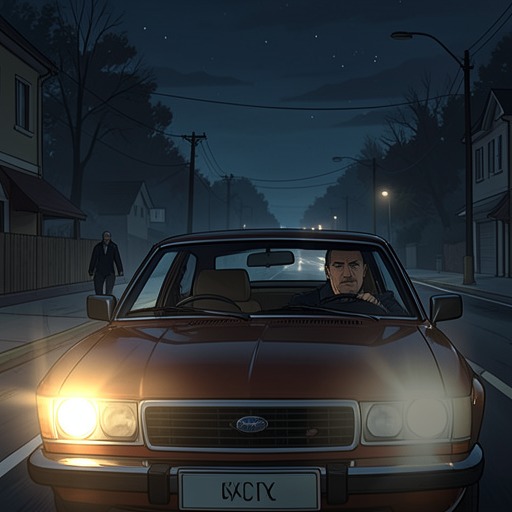
The optimism is short-lived. On the road, David and Jo argue as they approach a sign, and a sandstorm briefly obscures the route. Two men run toward their car, one holding a cardboard sign advertising fossils. Jo calmly tells David to stop, but the car continues and strikes a man. The collision kills Driss. The abruptness of the event, and the storm’s interruption of visibility, become part of David’s account of what happened; they do not, however, prevent him from having ignored Jo’s warning.
Collision and Denial
After the collision, David insists that it was not his fault. At the guest quarters, Richard Galloway finds him breathing heavily and indignant, unable to talk himself out of his own innocence even when he is being truthful. The scene establishes a central contradiction in David: he is not simply inventing an account he knows to be false, but is capable of holding tightly to his innocence while the circumstances press against it.
When Yassine Benihadd makes him recount the accident, David emphasizes the sudden sandstorm and their disorientation. Later, Richard argues that he should pay rather than allow the situation to worsen. David rejects the idea that someone should be paid because of an accident. His refusal rests on a principle as he understands it, but it also keeps him from acknowledging how the family and community might understand his responsibility. The difference between legal exoneration and forgiveness becomes increasingly important to him: he comes to see that official treatment of the collision cannot provide the personal absolution he wants.
David also interprets the demand that he travel to Abdellah’s village through suspicion. He imagines that the family will hold him there until he gives them money, and describes their position to himself in terms of extortion and hostility toward outsiders. Yet he anticipates that Richard will urge him to go, recognizes that the journey may be easier than continued resistance, and feels relief at the possibility that Abdellah might forgive him. The decision is thus both reluctant compliance and a search for a form of absolution that money or official judgment cannot supply.
Journey and Captivity
At the departure from Richard’s ksour, David is sent off with his two bags and a sleeping bag for the stone floors at his destination. The farewell is marked by small, formal gestures: boys carry his luggage and serve minted lemonade, while Richard explains the practical provision of bedding. David’s departure makes the journey feel less like a voluntary visit than a passage into an uncertain household and a different set of expectations.
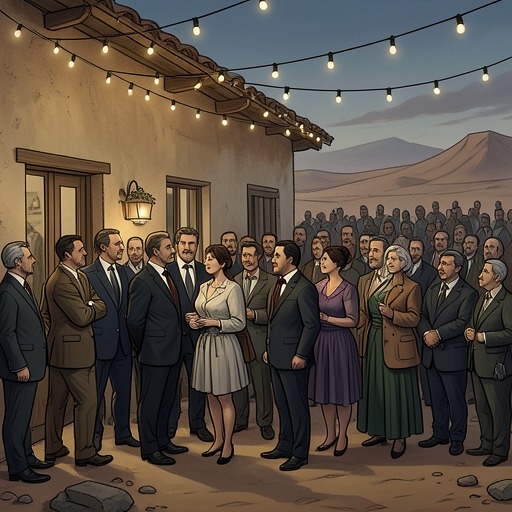
At Tafal’aalt, David experiences his dependence on Abdellah’s household as captivity. His interpretations remain defensive: he sees the presence of Driss’s belongings as an attempt to make him feel the dead boy’s presence and to torment him. In Driss’s room he notices a jar holding a pen, a small British Dalek toy, folded underclothes, and a notebook. These ordinary objects belonged to a teenager, but David initially reads them through his fear and guilt rather than as evidence of the boy’s everyday life. His attention to them also brings him into contact with the life that ended before the collision.
The village’s poverty and dependence on fossil work further complicate David’s assumptions. He is appalled by children working in the caves, and recognizes that Driss had been among them. The landscape does not simply function as a backdrop to his ordeal: the labor he sees ties the dead boy to the conditions of life in Tafal’aalt, while David’s earlier view of the people as driven by money begins to lose its certainty.
His encounter with Abdellah is charged by the objects between them. Abdellah arrives with a candle set on a saucer, has shaved his head, and speaks French fluently. When David begins to explain himself, Abdellah tells him to sit, places two apples beside him, and sets down the SOG knife he had used to peel them. David’s attention is caught by the knife, but the scene also places ordinary hospitality beside the possibility of threat. Later, in the wind near dawn, Abdellah takes out the same knife and points it toward Alnif rather than advancing. He tells David that Anouar will take him back and that his bags are already loaded. David is released rather than harmed, and the decision gives his stay an ending he can interpret as mercy.
Release and Self-Interpretation
On the drive back, Anouar passes Rissani, then continues through Erfoud without stopping for water. A mobile-phone signal returns outside Errachidia, allowing David to call home. He tells the person at the other end that everything is fine, that a man from Tafal’aalt is driving him back, and that he expects to arrive in time for brunch. He also says that he will speak to Richard and will have difficulty forgiving him for what he believes Richard knew.
David’s call presents a composed account of his return, but his private interpretation is less settled. He imagines that he would forgive anyone in exchange for a hot bath and a gin and tonic, and treats his ordeal as something that has earned him small comforts. He also believes that his experience has made him stronger and that he has, in some sense, changed sides. Despite his earlier suspicions, he now regards Abdellah as impressive and revises his judgment of the village: he concludes that its people are not motivated by money in the way materialistic Westerners assume. These conclusions mark a real shift in David’s perceptions, even as he continues to maintain that the accident was not his fault.
The bag of money remains a complication in his account of what has happened. David thinks that returning with it would lead Richard and Jo to assume he had withheld it on principle, though he expects they would misunderstand his reasons. His concern reveals that the journey has not produced an uncomplicated reconciliation between his own conduct and other people’s judgments. He wants his experience to count as proof that he has been forgiven, while still anticipating that those closest to him will read his choices differently.
Ending and Narrative Role
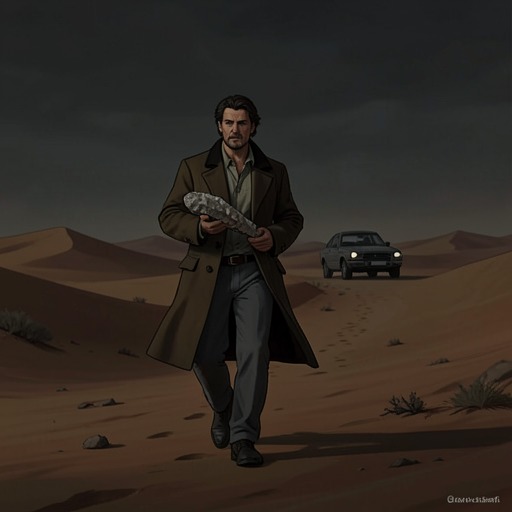
David’s apparent return to ordinary life does not close the consequences of the collision. When he and Jo later travel by car, Ismael approaches them carrying a Psychopyge fossil and a revolver. He recognizes David as the man who buried Driss’s identification. David, in turn, understands who Ismael is. The earlier concealment, which David’s account of the accident and his experience at Tafal’aalt have not erased, becomes the link between the two men in this final encounter.
David’s last thoughts turn on the belief that he has already forgiven himself. He does not understand why he has not been forgiven by Ismael, and in the moment of recognition he feels that freedom of choice is absurd. His ending therefore sharply separates self-forgiveness from the forgiveness of others: an inward sense of absolution cannot determine how the person harmed, or those who loved him, will respond. David is a character defined by that gap. He can revise his view of Abdellah and the people of Tafal’aalt, and he can feel changed by his ordeal, yet he cannot make his self-understanding the final measure of responsibility. The collision begins with his refusal to stop; the return journey offers an experience he mistakes for closure; and Ismael’s recognition shows that the consequences he tried to leave behind have remained present.